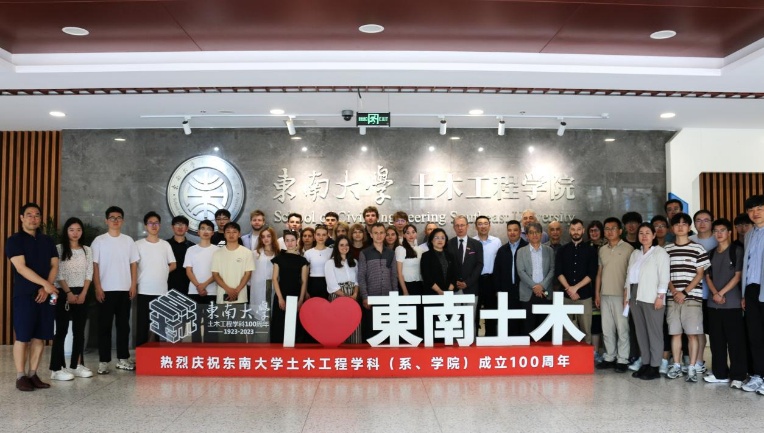
On the morning of May 22, the School of Civil Engineering held the opening ceremony of the China-Poland International Workshop on Advanced Lightweight Structures and Energy Absorption, along with the appointment ceremony for Professor Romuald Tarczewski as a guest Professor of Southeast University. Attending the ceremony were Ms. Jian Xu, Deputy Director of the SEU International Cooperation Office; Mr. Dinghua Tang, Deputy Party Secretary (Presiding over Daily Affairs) of the School of Civil Engineering; Professor Jianguo Cai, Assistant Dean; Professor SeungDeog Kim; Professor Romuald Tarczewski and Associate Professor Marcin Brzezicki from Wroclaw University of Science and Technology, Poland; Professor Pino Trogu from San Francisco State University, USA; Dr. Vegh Petr, Vice President of Pretium Engineering, Canada; Professor Olga Popovic Larsen and Associate Professor Daniel S-H LEE from the Royal Danish Academy, Denmark; Assistant Professor Sung-Jun Pang from Chonnam National University, South Korea; and over 60 faculty and student representatives from SEU and Wroclaw University of Science and Technology. The ceremony was chaired by Professor Jianguo Cai.
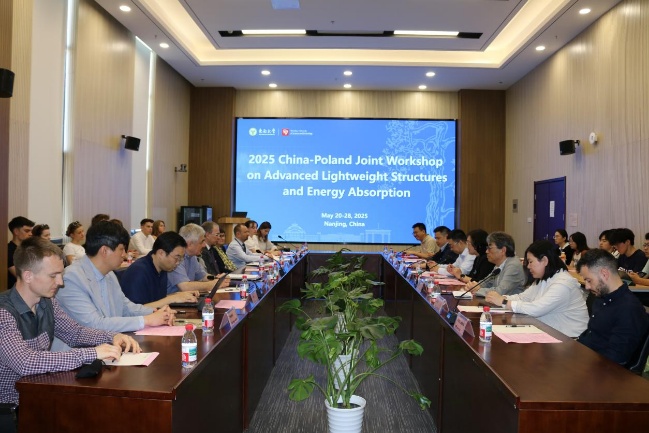
In her welcome address, Deputy Director Jian Xu briefly introduced SEU and reviewed the university's collaboration achievements with top international institutions. She extended sincere congratulations on the opening of the China-Poland International Workshop. Welcoming Professor Tarczewski, she expressed hope that the appointment would further deepen academic exchanges and cooperation, injecting new vitality into the university's disciplinary development and talent cultivation. Mr. Dinghua Tang, Deputy Party Secretary (Presiding over Daily Affairs), also warmly welcomed Professor Tarczewski and provided an overview of the school. He noted that hosting international workshops and appointing guest professors are key components of the school's internationalization strategy, aiming to promote disciplinary advancement through academic exchange and collaboration.
Dr. Marcin Brzezicki from Wroclaw University of Science and Technology expressed sincere gratitude to the School of Civil Engineering at SEU for organizing the workshop. He emphasized that the workshop provides not only a learning platform for students but also a bridge for cooperation and exchange between the two universities, expressing hope for further strengthening their partnership. Polish student representative Alina Ewertowska shared her honor in participating in the international workshop in China, viewing it as both a valuable opportunity to gain professional knowledge and a rich cross-cultural experience. She expressed great anticipation for the upcoming workshop activities.
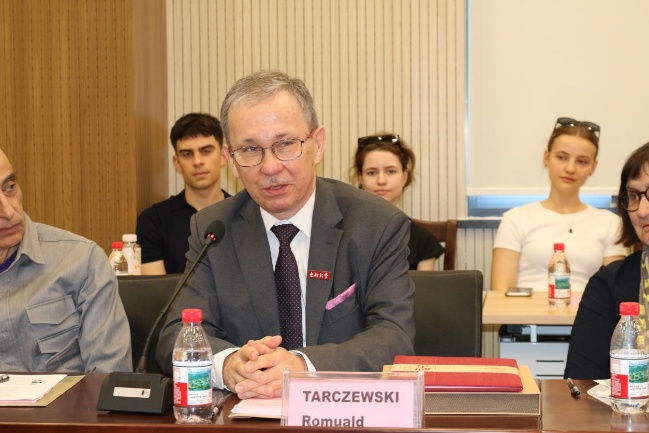
Professor SeungDeog Kim then introduced Professor Romuald Tarczewski. Professor Tarczewski is a member of the Advisory Committee and former Executive Committee member of the International Association for Shell and Spatial Structures (IASS), and an Executive Committee member of the Structural Engineers World Congress (SEWC). His research focuses on contemporary structural design and construction systems for architecture, structural topology optimization, membrane and pneumatic structure design, shell and spatial structures, as well as structural reinforcement of historical buildings and heritage conservation.
Professor Romuald Tarczewski spoke about his connection with SEU and its School of Civil Engineering, expressing gratitude for the recognition and trust bestowed upon him. He stated his commitment to collaborating with SEU on joint graduate student supervision and academic research.
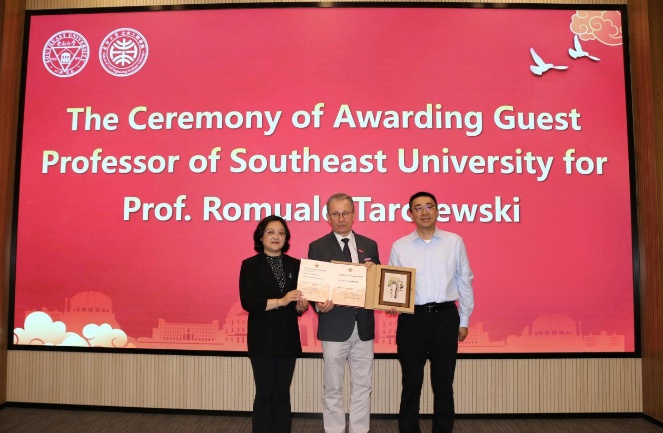
Finally, Deputy Director Jian Xu and Mr. Dinghua Tang presented Professor Romuald Tarczewski with the guest Professor appointment certificate and pinned the SEU badge on him.
Following the ceremony, Professor Romuald Tarczewski delivered an academic lecture titled "Large and small–Unobvious relationships in art and structures." The report explored the fractal nature of the world, highlighting the apparent similarities between objects at different scales. It demonstrated how similar modeling and analytical strategies are applied in art, architecture, and structures, showcasing the potential value of applying fractal theory to design and engineering practice.