Recently, through the recommendation and selection process by the editorial team of the ASME Journal of Mechanical Design (IF=3.441), the origami research paper titled “Particle swarm optimization-based metaheuristic design generation of non-trivial flat-foldable origami tessellations with degree-4 vertices”, led by Professors Chen Yao and Feng Jian from the Department of Civil Engineering at our university, was awarded the “Editors’ Choice Award” by the ASME JMD journal editor (Note: Only 1-2 papers are selected each year, with an acceptance rate of approximately 1.1%).
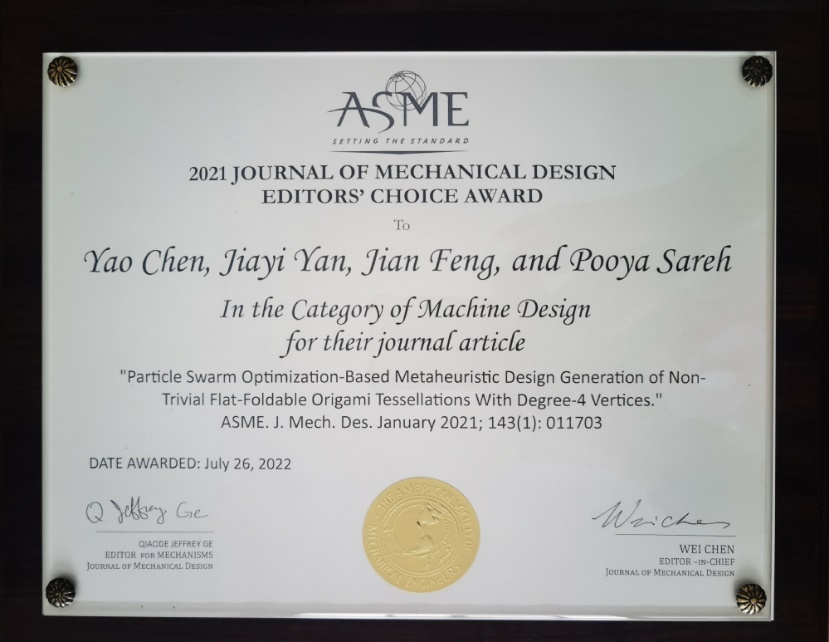 Editors’ Choice Award
In recent years, origami structures have rapidly developed and been successfully applied in various fields such as architectural structures, aerospace, flexible electronics, medical devices, mechanics metamaterials, novel mechanisms, and robotics. However, challenges still exist, including the difficulty in constructing new origami configurations and the coordination between structural configuration and folding performance. In order to develop new origami structures, this research fully considers the periodic symmetry and foldability of origami configurations. It takes the lead in using geometric-graphical methods to describe the four-fold crease origami configuration and establishes a system of geometric constraint equations for origami boundaries and crease vertices. Subsequently, a constrained optimization model for generalized four-fold crease origami structures is constructed. Considering the requirements of structural design and engineering applications, a particle swarm heuristic algorithm is introduced to seek all foldable points under given boundary conditions. This achieves efficient design and optimization of generalized four-fold crease origami structures. The origami design method is applicable to four-fold crease origami structures under arbitrary boundary conditions, providing technical support for applications such as deployable roofs, folding facades, expandable bridges, and cushioning energy-absorbing structures/components.
In addition, according to the Essential Science Indicators (ESI) updated data, this research work has been included in the ESI highly cited papers. The study received funding from the National Natural Science Foundation of China, the Zhongying Young Scholars Program of Southeast University, and the Humboldt Research Fund in Germany.
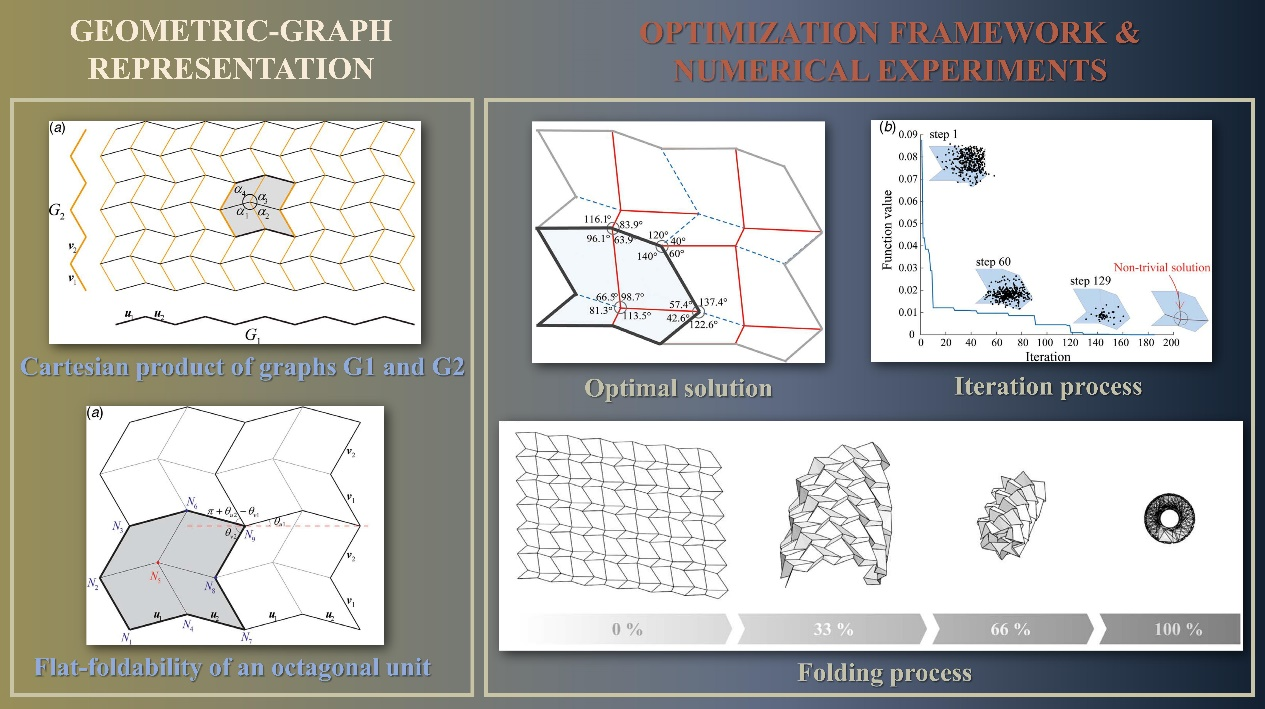
Design and Optimization of a Novel Four-Fold Crease Paper Structure