On August 27, 2021, the official launch event of the 'Southeast University Donghe Building Carbon Emission Calculation and Analysis Software'—the first lightweight building carbon emission calculation and analysis software in the country, edited by our university's team, was held formally through a combination of online live streaming and offline presentation. The offline event took place at the 'Jiangsu Provincial Modernization and Innovation Exhibition Hall of the Construction Industry' in Jiangning High-tech Zone, Nanjing. The event was jointly organized by the Southeast University National and Local Joint Engineering Research Center for Intelligent Construction and Operation, the National Prestressed Engineering Technology Research Center, and the Jiangsu Provincial Collaborative Innovation Center for New-Type Building Industrialization. Our university, along with the Southeast University Liyang Infrastructure Safety and Intelligent Technology Innovation Center, and the Jiangsu Dongyin Intelligent Engineering Technology Research Institute, jointly undertook the organization. Leaders and experts attending the event included Gu Xiaoping, Party Secretary of the Jiangsu Provincial Department of Housing and Urban-Rural Development, Miao Changwen, Academician of the Chinese Academy of Engineering, and Wu Gang, Vice President of Southeast University. Representatives of industry leaders from engineering consulting, design, construction, and real estate companies in Nanjing also attended the launch event.
The press conference was divided into two sessions, with the first session chaired by Professor Lu Weibing, Executive Vice Dean of the Research Institute of Southeast University. Vice President Wu Gang, on behalf of Southeast University, expressed sincere gratitude and a warm welcome to the government leaders, corporate guests, and online audience attending the event. He analyzed the pain points in the field of building carbon emission calculation software, both domestically and internationally, such as the scarcity of specialized tools, weak analysis functions, high usage thresholds, and short coverage periods. Vice President Wu introduced the team led by our faculty, leveraging the strengths of Southeast University's disciplines, including civil engineering and architecture, ranked A+ in the fourth round of the Ministry of Education's discipline rankings. He highlighted the establishment of research platforms such as the National Prestressed Engineering Technology Research Center, the National-Local Joint Engineering Research Center for Intelligent Construction and Operation, and the Ministry of Education Engineering Research Center for Low-Carbon Building Environment Equipment and System Energy Conservation. He emphasized the team's research achievements in the field of green, low-carbon, and sustainable development over the years. Based on the national standard Building Carbon Emission Calculation Standard GB/T51366-2019, Vice President Wu announced the independent development of the Southeast University Donghe Building Carbon Emission Calculation and Analysis Software by our team. He emphasized its advantages of lightweight design, convenience, traceability, and full life cycle coverage. He welcomed everyone to use the software, contributing collectively to the realization of China's major dual-carbon strategy. Following this, Vice Dean Li Dezhi provided a detailed introduction to the software, covering its construction background, development process, software design, and future development vision. In the final part of the session, Secretary Gu Xiaoping and Academician Miao Changwen jointly announced the official release of the Southeast University Donghe Building Carbon Emission Calculation and Analysis Software, marking its integration into the Southeast University Intelligent Construction Cloud platform (http://seuicc.com:8080).
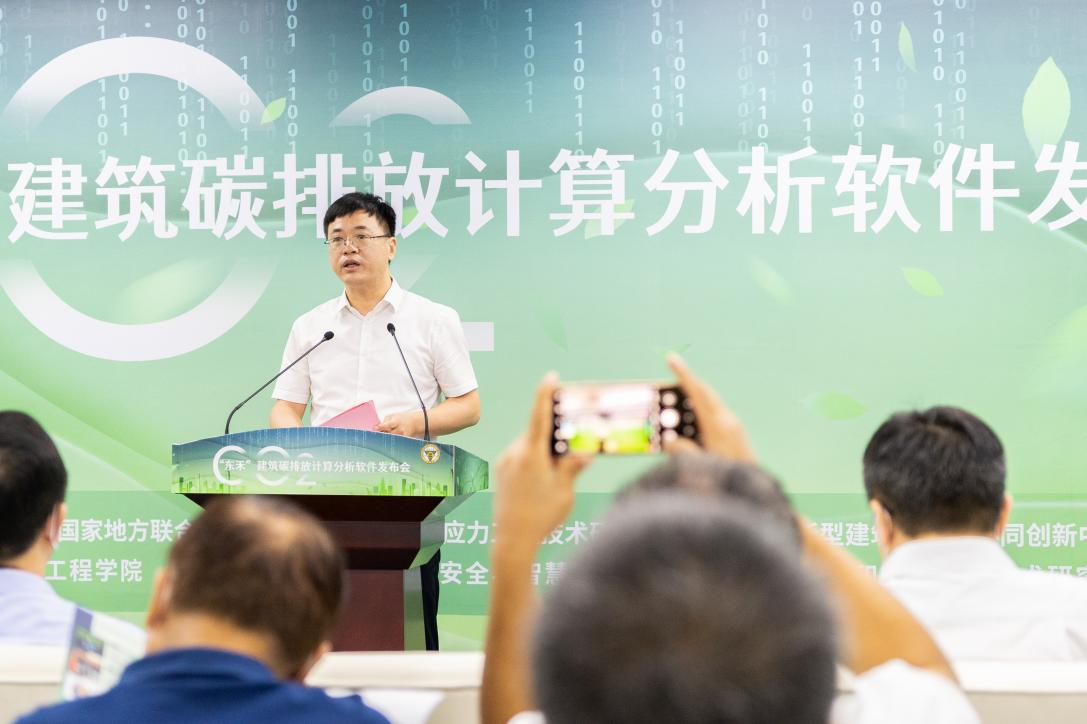
Vice President Wu Gang presented the university's address and outlined the research and development context.
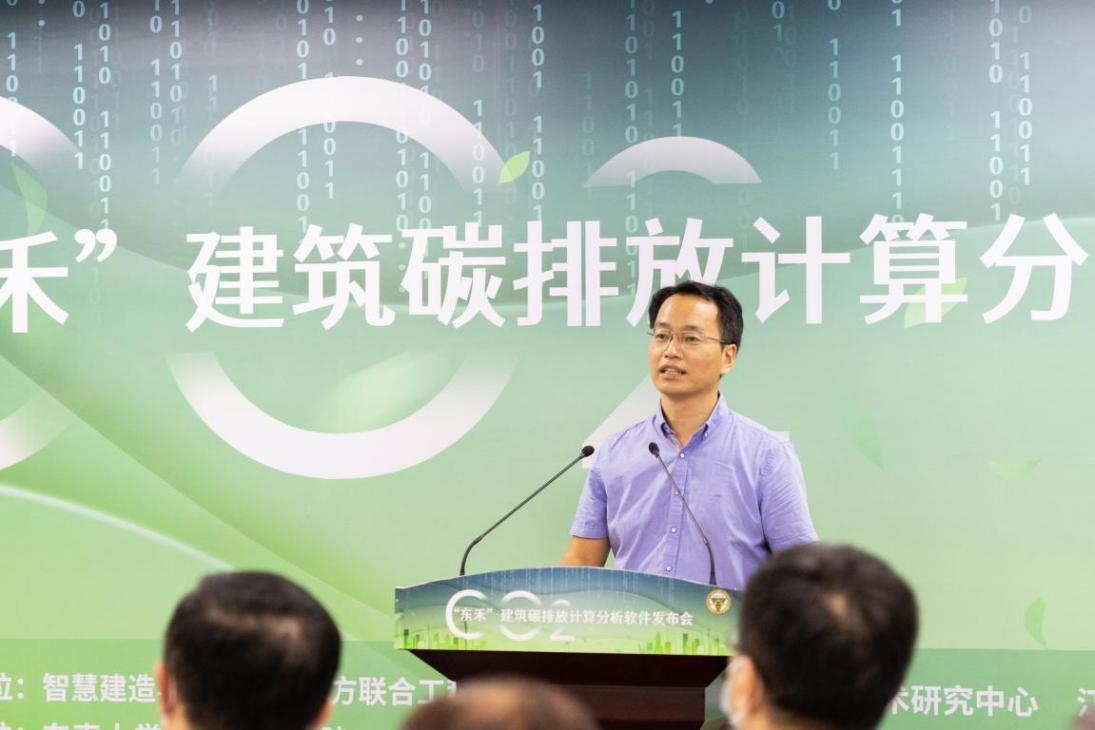
Deputy Dean Li Dezhi of the school of civil engineering presented the carbon emission analysis and calculation software.
The second session featured a closed-door symposium on the theme of Transformation, Upgrading, and High-Quality Development of the Construction Industry Guided by the 'Dual Carbon' Initiative, chaired by Vice President Wu Gang. Initially, Dean Zhang Tong of the School of Architecture, Li Xia, Deputy Dean (in charge of work) of the School of Civil Engineering, and Zhao Dongliang, Vice Dean of the Southeast University Yangtze River Delta Carbon Neutrality Strategic Development Institute, respectively, presented the research progress and plans in various disciplines related to the dual carbon initiative in the field of construction. Subsequently, leaders from participating enterprises, including Zhao Wei, General Manager of Jiangsu Provincial Architectural Design and Research Institute Co., Ltd., Zhou Yi, Deputy General Manager of Jiangsu Engineering Consulting Center, Cheng Jianjun, Chief Engineer of China Construction Eighth Engineering Division Corp., Gao Baojian, Vice President of Jiangsu Construction Engineering Group Co., Ltd., Liu Jianshi, Deputy General Manager of Nanjing Anju Construction Group Co., Ltd., and Cao Wei, Executive Vice Dean of Southeast University Architectural Design and Research Institute Co., Ltd., successively introduced their companies' distinctive practices in green and low-carbon initiatives, as well as their visions for university-industry cooperation. Following this, government officials, including Cao Yang, Deputy Director of Jiangning District Urban and Rural Construction Bureau, Wang Zhiqiang, Director of the Building Management Department of the Jiangsu Provincial Department of Housing and Urban-Rural Development, Dai Dengjun, Director of the Fire Department of the Jiangsu Provincial Department of Housing and Urban-Rural Development, He Lingjun, Director of the Design Department, and Cai Yuting, Director of the Technology Department of the Jiangsu Provincial Department of Housing and Urban-Rural Development, expressed expectations and collaboration intentions regarding the Southeast University Donghe Building Carbon Emission Calculation and Analysis Software and Southeast University's service in the province's dual carbon construction field, each in their respective areas of responsibility.
During the symposium, Gu Xiaoping, Secretary of the Party Committee of the Jiangsu Provincial Department of Housing and Urban-Rural Development, fully acknowledged the pioneering significance of the Southeast University Donghe Building Carbon Emission Calculation and Analysis Software and Southeast University's exemplary leadership in internal disciplinary integration and university-industry resource fusion. He put forward three suggestions: Firstly, to systematically carry out carbon emission calculation and analysis, expanding the scope to various types of buildings such as hospitals, schools, and airports, as well as extending it to infrastructure, parks, and urban areas. Secondly, to further strengthen disciplinary integration by innovating institutional mechanisms, such as jointly undertaking major projects, establishing a sound reward and punishment system, setting ambitious goals, and developing demonstration pilot projects. This aims to better leverage the synergies within Southeast University's advantageous disciplines, including civil engineering, in the field of low-carbon construction. Thirdly, to enhance the integration of industry, academia, and research by strengthening collaboration with consulting, design, construction, and real estate enterprises in the province. This collaborative effort aims to coordinate and promote the transformation, upgrading, and high-quality development of the construction industry in Jiangsu Province.
In conclusion, Academician Miao Changwen fully endorsed and sincerely appreciated Secretary Gu's suggestions, committing to earnestly implement them. He pledged to diligently carry out disciplinary integration and university-industry fusion, aiming to establish low-carbon initiatives as a new standout brand at Southeast University. Vice President Wu Gang expressed deep gratitude to Secretary Gu and all leaders and entrepreneurs for their long-term care and support for Southeast University. He stated that Southeast University would, in the future, develop a series of software, build a world-class civil engineering and construction platform, implement a set of demonstration projects, and focus on national strategic priorities. The university is committed to fully supporting the new development pattern of dual circulation.
It is reported that the Southeast University Donghe Building Carbon Emission Calculation and Analysis Software was personally directed and deployed by Vice President Wu Gang. The compilation work officially started in mid-April 2021. The research and development team primarily consisted of faculty members from our institution, including Li Dezhi, Yuan Jingfeng, Ou Xiaoxing, Zhu Lei, Zheng Saina, Su Shu, and Professor Zhang Linfeng from the School of Transportation. Additionally, members from the Nanjing-based research institution, Jiangsu Dongyin Smart Engineering Technology Research Institute Co., Ltd., where our professors serve as legal representatives, included Zhang Hua, Liu Longqiang, Wei Yushen, Liu Yanjiao, Zheng Yuanwei, Fu Yu, and others. Throughout the compilation process, the research and development team prioritized user-centric thinking. As a result, the software eliminates the need for the pre-installation of large, complex modeling software for architecture, structure, and electromechanical systems. Users can input basic building information, as well as energy consumption, resource consumption, and waste emission information at various stages such as materials production and transportation, construction, operation, and dismantling, directly into predefined templates. The software also allows for the direct import of results from mainstream commercial software used for calculating construction project consumption and green building energy consumption analysis. Its lightweight design and specialized features make it suitable for various building types and climate regions. Moreover, the software provides carbon emission calculation results at different granularities, supporting dynamic accounting and intelligent decision-making for carbon emissions reduction in various user types, including engineering consulting, design, construction, and real estate development and operation. Presently, the software has obtained computer software copyright registration certificates from the National Copyright Administration of China for its mobile, tablet, mini-program, and web versions.
The Southeast University Donghe Building Carbon Emission Calculation and Analysis Software, developed and released by our team, is believed to be a forward-looking technological achievement under the strategic decision framework of the national goal to strive for carbon peak by 2030 and carbon neutrality by 2060. Through continuous iteration, upgrading, and practical application, the software has evolved from a leader to a pioneer in building carbon emission calculation and analysis software. It effectively contributes to the realization of China's dual carbon goals in the construction industry, supporting the sector's transformation, upgrading, and high-quality development.