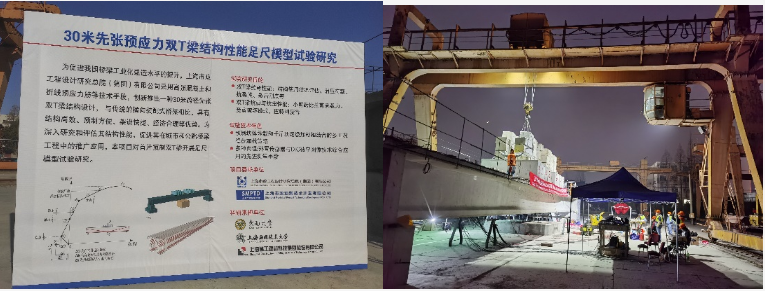
On January 15, 2021, a novel full-scale bending performance test of pre-stressed double T- beams, led by Professor Liu Zhao's team at Southeast University, was successfully conducted at the Third Component Factory of Shanghai Construction Materials Engineering Co., Ltd.
The innovative bridge structure, designed by Shanghai Municipal Engineering Design Institute (Group) Co., Ltd., incorporates key features such as a dual-T cross-section, high-strength self-compacting concrete, dual-line pre-stressing arrangement, and the absence of intermediate transverse diaphragms. Compared to traditional transverse assembly bridges, it offers advantages in structural efficiency, convenient prefabrication, quick installation, and economic feasibility. To thoroughly study and evaluate the entire process and structural performance of these double T-beams, Shanghai Municipal Engineering Design Institute (Group) Co., Ltd., and Shanghai Municipal Precast Technology Development Co., Ltd. entrusted Professor Liu Zhao from Southeast University to lead the research. The project also involved collaboration with Professor Ding Wensheng's team from Shanghai University of Applied Technology and Shanghai Construction Building Materials Science and Technology Group Co., Ltd. To enrich research results, the research team invited Professor He Xiaoyuan's team from our school to conduct structural tests using Digital Image Correlation (DIC) technology during the loading process. Additionally, the experiment received strong technical support from teachers Lu Fei and Xu Ming from the School of Civil Engineering at Southeast University, Professor Tang Liang from Southwest Jiaotong University, and Sun Changjun, Chief Engineer at OVM, Liuzhou.
The scale and difficulty of this unprecedented large-scale bridge test were notable both domestically and internationally. The experiment, planned and initiated in July 2020, saw members of the Southeast University research team settling in at Shanghai Construction's Third Component Factory in late October. They commenced the design and production of the test stand, deploying various sensors at hundreds of measurement points, and fabricating the test beams.
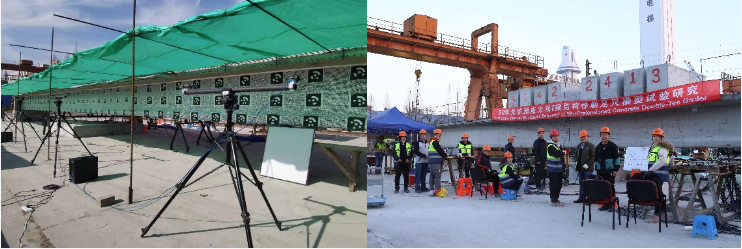
The technical features of this full-scale bending test are distinctive. The loading strategy combines prefabricated block stacking and jack loading in a staged and steady manner. The testing plan incorporates various embedded and external sensors, along with DIC technology, to measure strains in ordinary steel bars, pre-stressed steel bars, and concrete, as well as surface strains on the beams. The bending test, from preloading to formal loading, was completed over three days, involving a total of 13 working conditions, achieving a comprehensive structural behavior assessment. Subsequently, the research team will conduct shear and torsional performance tests on the test beam.
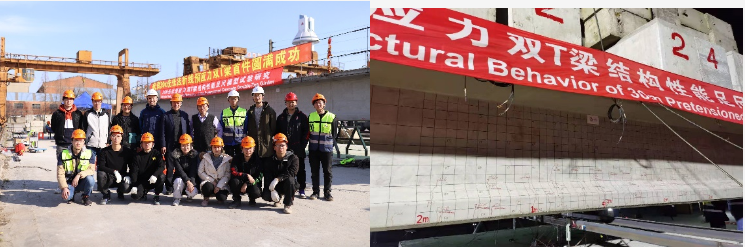
The success of this experiment is credited to the dedicated efforts of over a dozen graduate students from our school who participated in the trial. In the collaborative process with the project owner and cooperating units over the past three months, Southeast University students demonstrated exceptional qualities of resilience, effective communication, practical courage, and a sense of responsibility, upholding the university motto of “Strive for perfection.”
| |
Fig.1. Display board at the test site | Fig.2. Load test site |
| |
Fig.3. DIC digital image related technology applications | Fig.4. Load test work site |
| |
Fig.5. A group photo of some test personnel on site | Fig.6. Cracks at the mid-span of the beam |